Monday, October 27, 2008

Democrats Consider Eliminating 401 (k) Tax Breaks

(Compiler's note: Must read -- if we go down this road, it will impact about 60% of our working people. This is yet another form of economic terrorism. Now some elements of the U.S. Gov't want our 401K. rca)

from News Cycle Blog

Want a glimpse into what an Obama administration and Democratic-controlled Congress will look at in the area of tax policy? House Democrats are already considering an overhaul of the nation's $3 trillion 401(k) system, including the elimination of most of the $80 billion in annual tax breaks that 401(k) investors receive.

Republicans are throwing around the "socialist" tag all over the campaign trail when referring to Sen. Barack Obama. But if the Democrats are even considering such a radical plan as to seize private pension accounts, it's hard not to look at Democrats in any other way.

James Pethokoukis of U.S. News & World Report wrote on a congressional hearing in the 401(k) matter:

House Democrats recently invited Teresa Ghilarducci, a professor at the New School of Social Research, to testify before a subcommittee on her idea to eliminate the preferential tax treatment of the popular retirement plans. In place of 401(k) plans, she would have workers transfer their dough into government-created "guaranteed retirement accounts" for every worker. The government would deposit $600 (inflation indexed) every year into the GRAs. Each worker would also have to save 5 percent of pay into the accounts, to which the government would pay a measly 3 percent return. Rep. Jim McDermott, a Democrat from Washington and chairman of the House Ways and Means Committee's Subcommittee on Income Security and Family Support, said that since "the savings rate isn't going up for the investment of $80 billion [in 401(k) tax breaks], we have to start to think about whether or not we want to continue to invest that $80 billion for a policy that's not generating what we now say it should."

The director of the Congressional Budget Office, Peter Orszag, also testified at the hearing and said that about $2 trillion in retirement savings has been lost over the past 15 months.

Workforce.com explains the rational in the move:

“I want to stop the federal subsidy of 401(k)s,” Ghilarducci said in an interview. “401(k)s can continue to exist, but they won’t have the benefit of the subsidy of the tax break.”

Under the current 401(k) system, investors are charged relatively high retail fees, Ghilarducci said.

“I want to spend our nation’s dollar for retirement security better. Everybody would now be covered” if the plan were adopted, Ghilarducci said.

She has been in contact with Miller and McDermott about her plan, and they are interested in pursuing it, she said.

“This [plan] certainly is intriguing,” said Mike DeCesare, press secretary for McDermott.

Blogger Ed Morrissey of Hot Air notes "that means your employer can no longer write off their contributions to your 401(k), and your capital gains would be taxable year to year. In other words, it becomes just another investment or savings account, with no tax benefit at all, and no employer contribution. Instead, Uncle Sam would give you your “matching” funds — up to a whopping $600 per year! Whoopee!"

This huge disruption of Americans' retirement plans may be only one element of an Obama Administration's tax hike on workers. The Wall Street Journal notes that "the prospect of these tax increases is now hanging over the economy like a pall, as investors and businesses wonder where and how heavily an Obama Administration and Congress would strike."

Here's what the Journal reported Rep. Barney Frank as commenting recently on tax increases:

"I think at this point there needs to be a focus on an immediate increase in spending and I think this is a time when deficit fear has to take a second seat. ... I believe later on there should be tax increases. Speaking personally, I think there are a lot of very rich people out there whom we can tax at a point down the road and recover some of the money."

The Journal then concludes:

Federal budget deficits are not something we obsess about, but eventually this new spending has to be paid for, and Barney Frank's comments only underscore that big tax increases are coming. The prospect of these tax increases is now hanging over the economy like a pall, as investors and businesses wonder where and how heavily an Obama Administration and Congress would strike. The pall is likely to continue well into 2009, as millions of Americans delay their investment decisions until they know how much their after-tax returns are likely to fall.

Trail of Odd Anthrax Cells Led FBI to Army Scientist

By Joby Warrick

In late October 2001, lab technician Terry Abshire placed a tray of anthrax cells under a microscope and spotted something so peculiar she had to look twice. It was two weeks after the country's worst bioterrorism attack, and Abshire, like others at the Army's Fort Detrick biodefense lab, was caught up in a frenzied search for clues that could help lead to the culprit. Down the hall, Bruce E. Ivins, the respected vaccine specialist, was looking, too.

Abshire focused her lens on a moldlike clump. Anthrax bacteria were growing here, but some of the cells were odd: strange shapes, strange textures, strange colors. These were mutants, or "morphs," genetic deviants scattered among the ordinary anthrax cells like chocolate chips in a cookie batter.

Unknowingly, Abshire had discovered a key to solving the anthrax case. But it would take nearly six years to develop the technology to allow FBI investigators to use it. ....

Who Wants to Be President?

(Compiler's note: Must read and consider .... rca)


It would be fitting symbolism for the next President to wear a crash helmet on Inauguration Day.

He will inherit an economy that will be stuck in either a depression or a slow grinding recession that no economic gimmick or "redistribution" will help.

And he will likely be thrown into a Middle East war between Israel, Iran, Syria, Hezbollah, and the United States.

Americans aren't weak and passive fatalists who go quietly to the slaughter. We fight to solve our national problems and overcome obstacles, no matter how great. But the die has been cast on this Wall Street meltdown, and now the brightest minds on the economy see long-term devastation ahead. Arthur Laffer, the father of the Reagan recovery writes in today's Wall Street Journal that "The Age of Prosperity is Over." He writes, "Financial panics, if left alone, rarely cause much damage to the real economy, output, employment or production." But government intervention does real damage. It was the case after the 1929 crash, and Laffer thinks it will be the case now, with the Bush-Pelosi-Paulson bailout attempt.

How bad could things get? Many younger Americans can't remember bad economic times, because they have never experienced them. Laffer reminds us that during the period of recession and stagflation between the Kennedy and Reagan booms, a period which constituted most of my childhood, "The average annual real return for U.S. assets compounded annually was -6% per year for 16 years." Between 1929 and 1932, the New York Times Index of stocks, the equivalent of today's Dow, contracted some 89%. Unemployment grew to 25% or more, and didn't fall below 10 percent until 1941, with the beginning of World War Two.

Ouch.

Economics guru Nouriel Roubini, the NYU professor dubbed "Dr. Doom" for precisely predicting the current Wall Street meltdown, now predicts "hundreds of hedge funds will go bust and stock markets may soon have to shut - perhaps for as long as a week - in order to stem the panic selling now sweeping the world." Roubani told the London Times that "the world economy was 'at a breaking point'. He believes the stock markets are now 'essentially in free fall' and 'we are reaching the point of sheer panic'."

Add to this carnival of gloom, a Middle East war. This one is easier to explain. An Israeli attack on Iranian nuclear installations in the months ahead is a military and geopolitical certainty, with or without a "green light" from an American president. If Iran's nuclear program is not stopped by diplomatic means, Israel will hit it, and not just with a few bunker busters. Commando teams will have to be dropped because the installations are so far underground. It will be a big operation, and will trigger an Iranian and Hezbollah offensive against Israel, probably sucking in Syria, especially if Damascus senses that Israel can be delivered a knockout blow.

Neither McCain nor Obama will be able to stop any of this. The next President will have to wear it.

An Open Letter to the Beneficiaries of America's Military Prowess

(Compiler's note: A must read. rca)

by Maj. W. Thomas Smith, Jr.

Dear reader,

I’m writing this in direct-address fashion because – as we near the 233rd birthday of our Marine Corps (born in a Philadelphia alehouse on Nov. 10, 1775) and Veterans Day (born of the armistice ending World War I, Nov. 11, 1918, exactly 90 years ago) – this is as much an appeal as it is an opinion piece.
I’ve often said, far too many Americans – through no fault of their own – take our military for granted.

Those who have never served in uniform – particularly those who have never slogged through the mud with a rifle nor known what it feels like to be awakened by ‘incoming’ – just sort of assume that America dominates all comers militarily because America has money (yeah, well, at least we used to) and superior technology. And we can be sure that money and technology do count in the successful prosecution of war.
But it’s much more.

America has been winning all of its wars since the colonial era, including Vietnam, which we clearly won militarily, but lost in Washington and on the broader homefront (we’ll save that for another discussion). But we have been winning – often against great odds – primarily for one reason: AMERICAN MILITARY TRADITION.

Unfortunately, too many of us take military tradition for granted because we incorrectly assume that tradition is “nice,” but largely insignificant.

I don’t condemn those who believe such. Most people simply have no frame of reference to appreciate just how amazingly efficient the American military is despite its being an arm of the far-too-often inefficient federal government.

But trust me, our military prowess – that prowess of the individual soldier, sailor, airman, Marine, and Coast Guardsman who has never failed to keep the wolf away from the door — is a direct result of our military tradition.

U.S. Marines, for instance, crushed the insurgents during the bloody battle of Fallujah (Nov.–Dec. 2004) and they did so in close-quarters fighting — often tooth-to-eyeball — where much of our technological wizardry was unable to be fully brought to bear.

Those young men were able to win against the enemy because they were Marines. They knew they were holding an unmatched reputation in trust. They had to fight and fight well. After all, they were standing on the shoulders of those giants of men who had successfully battled the enemy in places with names like Hue City, Khe Sanh, Chosin, Iwo Jima, Tarawa, Guadalcanal, Belleau Wood, Harper’s Ferry, Chapultepec (the halls of Montezuma),
Quallah Batto, the stronghold and shores of Tripoli, and in nearly every other “clime and place” stretching back to the seaborne slugfests of Captain John Paul Jones’ leathernecks during the American Revolution.

So why all this talk of military tradition?

Because the greatest pillars of our military tradition are our Medal of Honor recipients – those combatants from all services who have received our nation’s highest award for bravery in action – and our greatest living pillars are our living recipients of that award. Their average age is now 75 years, and there are now less than 100 of them still with us. Most recipients are killed during the actions for which they receive the award. In fact, all who have received the award for actions since the end of the Vietnam War have died in those actions.

Now to my personal appeal to you, the reader:

The Medal of Honor Society will hold its annual convention – hosted by the S.C. State Guard Foundation and the Citadel – in Charleston, S.C., Sept. 2010, and I urge your support of this convention now as it will serve to promote public awareness of the Medal of Honor, our living recipients, and at-the-same-time infuse our military tradition with the lifeblood so necessary to future battlefield success.

We Americans are the most generous people on earth. We’re also frugal and savvy: We expect a return on investment, which is one of the reasons I know many of you may not yet be sold on the idea of the value of investing in something like military tradition. But I can assure you – as one who has served his country in-and-out of uniform for years – America’s military tradition is not only a priceless commodity and one that appreciates in value; I am convinced it is critical to the continued security of this nation.

That’s why I’m asking you to support our military and our American military tradition through this noble endeavor. Please visit medalofhonorconvention.com for more information and sponsorship opportunities available. You are not only going to be supporting the very foundation of our military prowess, but you will be furthering an awareness of America’s greatest heroes in the purest sense of the word.

Semper Fidelis,
W. Thomas Smith Jr.

Obama Advisor Praises Iran

by Ed Lasky

Well, is it that hard to believe in this day and age that a major American newspaper offers up an op-ed filled with praise for Iran? This would be Friday's Boston Globe in an op-ed written by Lawrence Korb and Laura Conley, both of whom work for the liberal minded Center for American Progress.

By the way, the fact that Korb has been identified as a key foreign policy adviser to Barack Obama is completely unmentioned – a major journalistic lapse but not a surprising one by the New York Times-owned Boston Globe.
Korb and Conley look upon Iranian efforts to help topple the Taliban as proof of the potential for Iran to work with America in bringing about some sort of Pax Persia in the region. This is a fallacy. Iran opposed the Taliban because the Taliban – a Sunni extremist group - hated the Shiite Persians that were on its border and hated the Shiites within Afghanistan. The Taliban murdered Iranian regime officials. The downfall of the Taliban was in the interest of the regime and their help when America sought to oust the Taliban was based strictly on self-interest. In the diplomatic realm, nations don't have permanent friends, they have permanent interests. The interests of the Iranian regime is regional hegemony and the acquisition of nuclear bombs.
Korb and Conley blame Bush for failure to reach out to the Iranians. This argument falls flat. In fact, various Bush officials have sought to reach out to the regime (as even the op-ed mentions in passing) but have been rebuffed – as have a long line of other Presidents who have tried to establish relations with the Iranians. This is a fact that the op-ed ignores.
The op-ed also seems to blame Bush for the progress of the Iranian nuclear program. This is absurd. The program did not start under Bush (and was actually temporarily put on hold in the wake of our invasion of Iraq) but had its origins going back to the 1980s. The program has progressed apace – under Democrat and Republican Presidents. We have sought, along with the United Nations and our European allies, to work with the Iranians to curb their nuclear program in return for various "carrots" offered to them. The result? Rebuff after rebuff, as the centrifuges spin away.
What is especially striking in this op-ed is the complete silence regarding the nature of the Iranian regime. One would hope that a foreign policy expert close to Barack Obama would at least recognize how important it is to consider the nature of a regime when advocating diplomatic outreach. Where is the recognition that the regime is – and has long been – designated as the number one terror-sponsoring nation in the world (as Bill Clinton so designated Iran)? Where is the recognition that Iran has been helping kill Americans in Iraq and has done so in Lebanon and Saudi Arabia, or the awareness that Iranian proxies have killed innocent Argentineans, Lebanese, Israelis and for that matter Iranians (a regime that hangs children and gays and brutalizes women wins praise from Korb and Conley?).
That little matter of denying the Holocaust while openly boasting of plans to bring about another one? The theological and apocalyptic musings of its leaders (not just President Mahmoud Ahmadinejad), the talk of halos and apocalypse spoken by Ahmadinejad from the podium of the United Nations to bring about the return of the missing Imam? Sheer piffle, not worth mentioning.

We will see more of these efforts to burnish Iran in the days ahead. The Iran lobby is stepping up efforts in Washington. The Persian red carpet is being rolled out.
Welcome to the future of our foreign relations under Barack Obama. Much like his campaign, it involves dreams and fantasy.

Petition Requests Presidential Candidate Prove Eligibility for Presidency

(Compiler's note: A must read. Please do your patriotic duty and send an e-mail. rca)

We urge all of you to contact your elected officials via email, U.S. Mail and/or by phone to deliver a like-minded message.
This is not a partisan matter; rather, it is an effort to protect our Constitution. Qualifications to serve as the U.S. president must be met, requirements must be satisfied, and unless we insist on this, we are not doing our civic duty to defend our sacred U.S. Constitution.
You can sign a petition, generate a letter and add a closing statement by clicking here.
The letter addresses this Constitutional concern by covering these issues.
Article II, Section 1 of the U.S. Constitution reads: "No Person except a natural born citizen, or a citizen of the United States at the time of the adoption of this constitution, shall be eligible to the Office of President; neither shall any person be eligible to that office who shall not have attained to the age of thirty five years, and been fourteen years a resident within the United States."
We would ask that both presidential candidates submit proof of their natural-born American citizenship. John McCain has addressed this issue, demonstrating that he was born in the Panama Canal Zone while his father was serving in the U.S. military. The Canal Zone was a U.S. territory at the time of his birth. Case closed.
On the other hand, on the web and in the media, there are numerous allegations surrounding Barack Obama's claim of natural birth in the U.S., all raising suspicion and doubt as to Obama's actual place of birth and thus qualification to run for the American presidency. So far, these allegations have not been addressed. Some of the assertions to which Philip Berg, an attorney who has filed suit in the Pennsylvania courts to request that Obama prove his eligibility, claims Obama "admitted" (due to no response within the allotted time period) and which one can find in Philip Berg’s suit are: Barack Obama was born in Mombassa, Kenya in 1961 while his mother, Stanley Ann Dunham, was married to Barack Obama Sr., a Kenyan; when his mother, divorced from Obama Sr., moved to Indonesia and married Lolo Soetoro, an Indonesian, Obama was adopted by Soetoro and became an Indonesian citizen; while in Indonesia, Obama had his name changed to Barry Soetoro; Obama traveled to Pakistan in 1981 under an Indonesian passport when Pakistan was a no travel zone for Americans. Additionally, there is an allegation that Obama's Kenyan grandmother claims that Obama was born in Kenya; Muammar Gadhafi, leader of Libya, has publicly claimed that Obama was born in Kenya and studied in Muslim schools in Indonesia.
A lawsuit in Honolulu in the First District Court is seeking a court order to open Obama's birth records. Obama has thus far neglected a Freedom of Information request for the records at two hospitals in Hawaii.
It’s reported that lawsuits in Washington, Georgia, California, Florida, New York and Connecticut are seeking state Superior Courts to force the states' Secretary of State, as the chief state elections officer, to perform their state constitutional duties to require original certifying birth records from Mr. Obama that would verify his birth in Hawaii.
Philip Berg's months-long lawsuit in Federal Court in Philadelphia reached a dramatic plateau as Mr. Obama and the Democratic National Committee (DNC) failed to respond to the court that Mr. Obama is not a natural born U.S. Citizen and therefore not qualified to run for office of President of the U.S. Berg believes they “admitted” to Obama's non-qualification by their failure to respond to a 30-day court ordered discovery in which Obama and the DNC were ordered to answer a petition by Berg. Mr. Berg has stated that if the Federal court chooses to dismiss he will appeal all the way to the Supreme Court. This has now come to pass.
These allegations will not go away until Mr. Obama produces proof to State and federal authorities. If he will not do so voluntarily he must be compelled by every means available.
If our elected representatives exercise their obligations as servants of the People and it turns out Mr. Obama is qualified, then there is no harm done. If they choose not to act on behalf of the people and it is proven that Mr. Obama is unqualified, they should carefully consider the personal political implications they may suffer due to their inaction.
Please go to the petition and do your civic duty today.
Brought to you by the editors and research staff of FamilySecurityMatters.org.

Obama's birth certificate sealed by Hawaii governor

(Compiler's note: If true that he is NOT a natural citizen, even if elected, Obama can NOT serve per the U.S. Constitution.)

By Jerome R. Corsi


Gov. Linda Lingle, R-Hawaii

HONOLULU, Hawaii – Although the legitimacy of Sen. Barack Obama's birth certificate has become a focus of intense speculation – and even several lawsuits – WND has learned that Hawaii's Gov. Linda Lingle has placed the candidate's birth certificate under seal and instructed the state's Department of Health to make sure no one in the press obtains access to the original document under any circumstances.

The governor's office officially declined a request made in writing by WND in Hawaii to obtain a copy of the hospital-generated original birth certificate of Barack Obama.

"It does not appear that Dr. Corsi is within any of these categories of persons with a direct and tangible interest in the birth certificate he seeks," wrote Roz Makuala, manager of constituent services in the governor's office, in an e-mailed response to a WND request seeking the information.

Those listed as entitled to obtain a copy of an original birth certificate include the person born, or "registrant" according to the legal description from the governor's office, the spouse or parent of the registrant, a descendant of the registrant, a person having a common ancestor with the registrant, a legal guardian of the registrant, or a person or agency acting on behalf of the registrant.

WND was told the official reason for denial of access to Obama's birth certificate would be authority granted pursuant to Section 338-18 of the Hawaii Revised Statutes, a provision the anonymous source claimed was designed to prevent identity theft.

Still, the source told WND confidentially the motivation for withholding the original birth certificate was political, although the source refused to disclose whether there was any information on the original birth certificate that would prove politically embarrassing to Obama.

Get the book that started it all, Jerome Corsi's "The Obama Nation," autographed by the author, exclusively from WND's online store for the amazing low price of just $4.95.

The source also refused to answer WND's question whether the original document on file with the Department of Health was a hospital-generated birth certificate or a registration of birth that may have been filed subsequent to the birth.

The anonymous source made clear the Hawaii Department of Health would immediately release Obama's original birth certificate, provided Obama requested the document be released, but the Department of Heath has received no such request from the senator or from anyone acting officially on his behalf.

WND also found on microfilm in the Honolulu downtown public library a notice published under the "Births, Marriages, Deaths" section of the Honolulu Sunday Advertiser for August 13, 1961, on page B-6, noting: "Mr. and Mrs. Barack II Obama. 6085 Kalanianaole-Hwy, son, Aug. 4."

In searching through the birth notices of the Honolulu Advertiser for 1961, WND found many birth notices were published between one and two weeks after the date of birth listed.

The notice in the Honolulu Advertiser does not list the hospital where the Obama son was born or the doctor who delivered the baby.

In a startling development, Obama's Kenyan grandmother has reportedly alleged she witnessed Obama's birth at the Coast Provincial Hospital in Mombasa, Kenya.

Friday, U.S. Federal judge Richard Barclay Surrick, a Clinton appointee, dismissed a lawsuit brought by Pennsylvania attorney Phillip J. Berg who alleged Obama was not a U.S. "natural born" citizen and therefore ineligible for the presidency under the specifications of the U.S. Constitution, under Article II, Section 1.

Berg told WND last week he does not have a copy of a Kenyan birth certificate for Obama that he alleges exists.

In Kenya, WND was told by government authorities that all documents concerning Obama were under seal until after the U.S. presidential election on November 4.

The Obama campaign website entitled "Fight the Smears" posts a state of Hawaii "Certificate of Live Birth" which is obviously not the original birth certificate generated by the hospital where Obama reportedly was born.

"Fight the Smears" declares, "The truth is, Barack Obama was born in the state of Hawaii in 1961, a native citizen of the United States of America."

Although the Obama campaign could immediately put an end to all the challenges by simply producing the candidate's original birth certificate, it has not done so. And the "Fight the Smears" website offers no explanation as to why Obama has refused to request, and make public, an original hospital-generated birth certificate which the Hawaii Department of Health may possess.

Quietly, quietly Australia conducts one Islamic terrorist trial after another…

from Winds of Jihad


Jihad by arson the next big thing?

* But remember: Islam is a “Religion of Peace”, Jihad is “inner struggle”,- its only a “tiny minority of extremists”- we cannot paint all Muslims with one brush and Islam is not a monolith and….

AAP

SIX Sydney men accused of conspiring to commit a terrorist act were strong adherents of the Islamic faith, driven by religion and ideology to carry out violent jihad against the Australian public, potential jurors have been told.

* Terror accused ‘planned fiery jihad’

* Nation at risk from ‘dirty bomb

Crown Prosecutor Richard Maidment SC today addressed the first 220 potential jurors for the NSW Supreme Court trial at the Parramatta court complex.

Bradley Umar Sariff Baladjam, 31, Khaled Cheikho, 35, Moustafa Cheikho, 31, Mohamed Ali Elomar, 43, Abdul Rakib Hasan, 39, and Mohammed Omar Jamal, 24, are accused of conspiring to commit acts in preparation for a terrorist act.

Mr Maidment said the men were conspiring to carry out acts of violence, including the detonation of explosives and use of firearms, between July 2004 and November 2005.

“The crown alleges that each of these men were apparently strong adherents to the Islamic faith and were each motivated by a particular religious, political or ideological cause - being the pursuit of violent jihad - which each of the accused apparently believed was founded in the teachings of the Islamic faith,” he told the jury pool.

“In essence, that meant that the accused were motivated to carry out violent activities against members of the Australian community as a whole, in pursuit of their ideals.”

Mr Maidment said the kind of terrorist acts contemplated by the men included the detonation of an explosive device, or devices, or the use of weapons.

The preparatory acts alleged included obtaining or seeking to obtain large quantities of firearms and ammunition, and significant quantities of chemicals which Mr Maidment said were for the purpose of making explosives “capable of causing substantial damage and loss of life.”

The judge, Anthony Whealy, urged the potential jurors not to offer themselves for service unless they were certain they could bring an unbiased mind to the trial.

“Each of the accused is entitled, and emphatically entitled, to the presumption of innocence,” Justice Whealy told jurors in the assembly room via videolink from the court.

“The fact that each is an adherent to the Muslim faith cannot be something that is allowed to raise any aspect of bias.

“It is important to repeat and stress that those who wish to serve on the jury should offer themselves for service only if they are able to bring an unbiased approach to persons of the Muslim faith.

“Similarly, if you are of the Muslim faith and harbour resentment to non-Muslims, you should not offer yourself for service.”

The jury selection process is expected to last the remainder of the week, with Justice Whealy telling the potential jurors the trial could take up to a year and involve 700 witnesses.


Feds Break Up Skin Heads Plot To Assassinate Obama

WASHINGTON (AP) -- Two white supremacists allegedly plotted to go on a national killing spree, shooting and decapitating black people and ultimately targeting Democratic presidential candidate Barack Obama, federal authorities said Monday.

In all, the two men whom officials describe as neo-Nazi skinheads planned to kill 88 people - 14 by beheading, according to documents unsealed in U.S. District Court in Jackson, Tenn. The numbers 88 and 14 are symbolic in the white supremacist community.

The spree, which initially targeted an unidentified predominantly African-American school, was to end with the two men driving toward Obama, "shooting at him from the windows," the court documents show[....]

Sheriffs' deputies in Crockett County, Tenn., arrested the two suspects - Daniel Cowart, 20, of Bells, Tenn., and Paul Schlesselman 18, of Helena-West Helena, Ark. - Oct. 22 on unspecified charges. "Once we arrested the defendants and suspected they had violated federal law, we immediately contacted federal authorities," said Crockett County Sheriff Troy Klyce.

Obama Bombshell Redistribution of Wealth Audio Uncovered

Another Obama special -- Must read -- listen!!

Sunday, October 26, 2008

Companies start competing for bailout money

By MARTIN CRUTSINGER

WASHINGTON (AP) - The bailout is now the hottest lobbying game in town.

Insurers, automakers and American subsidiaries of foreign banks all want the Treasury Department to cut them a piece of the largest government rescue in U.S. history.

The betting is that many with their hands out will be successful, especially with financial markets in a stomach-churning dive and predictions the economy is about to tumble into a deep recession.

These groups argue that the credit squeeze is so severe and the risks to the economy so dire that their industries need financial support as well.

The Treasury is considering requests from a variety of industries, but has not decided whether to expand the program, officials said Saturday.

Lobbying efforts are intensifying.

The Financial Services Roundtable wrote Treasury officials on Friday requesting that the initiative to buy $250 billion in bank stock grow to cover insurers, auto companies, securities dealers and U.S. subsidiaries of foreign companies, including banks. The Treasury's plan is intended to bolster banks' tattered balance sheets and get them to resume making loans.

As the Treasury now interprets it, these additional groups would not participate in the bank stock program. They could receive help from a separate part of the $700 billion rescue that will buy bad assets from financial institutions.

Steve Bartlett, the president of the Roundtable, urged the Treasury to broaden the definition of those eligible for the stock purchase program.

"The institutions that are excluded play a vital role in the U.S. economy by providing liquidity to the market," Bartlett wrote Neel Kashkari, the Treasury Department official running the bailout program.

Referring to U.S. subsidiaries of foreign companies, Bartlett said, "This is a global crisis and to not recognize the U.S. firms controlled by foreign banks or companies would create further impediment to the market's recovery."

A financial industry official said Treasury Secretary Henry Paulson met over the past week with various groups, including hedge fund managers, that were petitioning for assistance. The official spoke on condition of anonymity because the Treasury has not made a decision.

Some insurers technically would be eligible for stock purchases now if they own subsidiaries that are savings and loan institutions regulated by the Office of Thrift Supervision.

Last month, American International Group, the country's largest insurance company, received an $85 billion loan from the Federal Reserve. Since then, it has gotten further support in an effort to withstand the biggest upheavals on Wall Street since the Great Depression.

Complicating the government's decision-making is that the Bush administration will not be in charge after Jan. 20. Paulson, who has said he has no intention of staying on the job, has pledged to consult with both campaigns on his bailout actions.

Democrat Barack Obama's presidential campaign said Friday it supported the effort by the auto industry to get money from the $250 billion made available for stock purchases. That would be in addition to $25 billion recently approved by Congress for low-interest loans to help the struggling industry retool and build fuel efficient vehicles.

The debate over expanding the bailout comes as the Treasury is rushing to get money out the door to the primary recipients: banks that sharply curtailed lending after suffering billions of dollars of losses on mortgage-related assets as home foreclosures soared in the housing slump.

Lawmakers are pressuring the Treasury to do more in the foreclosure area, as well.

Sheila Bair, head of the Federal Deposit Insurance Corp., told Congress about efforts to provide government-backed loan guarantees for mortgages that are reworked to help homeowners in danger of default. That would give banks an incentive to speed up refinancing efforts because the government would back part of the reworked loan.

The Treasury also is moving ahead to get bank stock purchases approved. It announced on Oct. 14 that it was spending $125 billion to buy stock in nine of the largest financial institutions. An announcement was expected Friday about a second round involving 20 to 22 other banks.

But it was decided each bank would announce its own agreements with the Treasury, out of concern that excluded banks could suffer a stock sell-off from disappointed investors.

PNC Financial Services Group Inc. (PNC) announced Friday it was acquiring National City Corp. (NCC) for $5.58 billion, in what was the first instance of a bank using fresh investments from the bailout program to make an acquisition. PNC said it had received $7.7 billion in cash through selling stock to the government under the program.

Frank envisions post-election stimulus from Democrats

NEW BEDFORD — After the November election, Democrats will push for a second economic stimulus package that includes money for the states' stalled infrastructure projects, along with help paying for healthcare expenses, food stamps and extended unemployment benefits, U.S. Rep. Barney Frank said Thursday.

In a meeting with the editorial board of The Standard-Times, Rep. Frank, D-Mass., also called for a 25 percent cut in military spending, saying the Pentagon has to start choosing from its many weapons programs, and that upper-income taxpayers are going to see an increase in what they are asked to pay.

The military cuts also mean getting out of Iraq sooner, he said.

"The people of Iraq want us out, and we want to stay over their objection," he said. "It's extraordinary." The Maliki government in Iraq "can't sell (the withdrawal deal with the U.S.) because it sounds like we're going to stay too long."

"I was teasing (U.S. Rep.) Jack Murtha (a key supporter of military budgets) and I said to him, 'For the first time, somebody else has got a bill that's almost as big as yours.' We don't need all these fancy new weapons. I think there needs to be additional review."

Rep. Frank called on President Bush to appoint a senior official to guide the economic stimulus packages through the transition to the Barack Obama or John McCain administration when it takes office in January.

And he said that if the Democrats can't find an adequate agreement on a stimulus package in the lame-duck Congress, they would rather wait until the new Congress takes over — likely with many more Democrats, if polling results bear fruit in the November voting.

The new package, he said, will be aimed at easing fears about lending and investing. "The psychological problem is even worse than the real problem," he said.

"There is money to lend and projects worth borrowing money to do. But people are afraid to lend. That's what we're trying to unfreeze."

States have many infrastructure projects — bridges, highways, etc. — that have been shut down because of a cash-flow problems, he said. So it is not the case that a stimulus will take months or years to wait for design and approval, since projects are already in progress or ready to go.

Also, he said, "we'll increase the federal share of medical care so states won't have to lay off people." Unemployment insurance benefits won't increase, he said, but the period of collecting them will, and eligibility requirements might be relaxed.

And, ultimately, there will be tax increases on the upper brackets. "We'll have to raise taxes ultimately. Not now, but eventually," he said.

Report: Iranian president has fallen ill

TEHRAN, Iran (AP) - Iranian President Mahmoud Ahmadinejad has fallen ill due to exhaustion brought on by his heavy workload, a close associate has told the Iranian state news agency.

The announcement comes as doubts have surfaced over whether Ahmadinejad, who faces strong criticism from opponents, will seek re-election next year.

Parliament member Mohammad Ismail Kowsari, an ally of the president, said late Saturday that Ahmadinejad was feeling under the weather because of the strain of his position, according to the news agency, IRNA. ....

Ball State Univ recreating 'War of the Worlds' broadcast

(Compiler's note: On a lighter note... rca)

MUNCIE, Ind. - Ball State University is preparing to recreate Orson Welles' 1938 broadcast of "The War of the Worlds" that sparked panic among some listeners who thought Earth was being invaded by aliens.

Indiana Public Radio General Manager Marcus Jackman said the re-enactment on Thursday night, 70 years after Welles' broadcast, will be a treat for attentive, creative listeners.

He's expecting a much more positive response than that incited by the original broadcast.

With the state of today's technology, organizers said it's safe to assume no one will be fooled by the actors' performance into thinking that Martians are invading the Earth.

"There will be a neat nostalgic payoff," he said. "But I doubt people will be panicking."

Mike Gerhard, a Ball State professor of telecommunications, will lead a pre-broadcast discussion about Welles' broadcast version of H.G. Wells' science fiction tale, and the fear it sparked. Another professor will make a presentation on Welles and his career.

The new production, a partnership between Indiana Public Radio and Ball State's telecommunications department, will be a live studio broadcast in Pruis Hall that will simultaneously air over local radio waves.

The audience in Pruis Hall will be able to see the mechanics in creating the music and sound effects, including the staff's pre-show preparations.

"When there's a live show, there's often some moments of terror right before the show. Well, the audience gets to see all of that unfold," said Nancy Carlson, an associate professor of telecommunications at Ball State.

Among some of the sound props are a cylinder that simulates siren noises and a signal generator that amplifies sounds.

Director Brian Boswell had some early trouble trying to find all the "bells and whistles" for the production. After some research and flea market shopping, he found authentic pieces that he keeps in his "box of sounds."

"Some sound effects were easier to do back then because they were available," he said.

On the Net:

Online audio streaming of the "The War of the Worlds": www.bsu.edu/ipr

------

Information from: The Herald Bulletin, http://www.theheraldbulletin.com

Nouriel Roubini: I fear the worst is yet to come

(Compiler's note: Must read. rca) baout

When this man predicted a global financial crisis more than a year ago, people laughed. Not any more...As stock markets headed off a cliff again last week, closely followed by currencies, and as meltdown threatened entire countries such as Hungary and Iceland, one voice was in demand above all others to steer us through the gloom: that of Dr Doom.

For years Dr Doom toiled in relative obscurity as a New York University economics professor under his alias, Nouriel Roubini. But after making a series of uncannily accurate predictions about the global meltdown, Roubini has become the prophet of his age, jetting around the world dispensing his advice and latest prognostications to politicians and businessmen desperate to know what happens next – and for any answer to the crisis.

While the economic sun was shining, most other economists scoffed at Roubini and his predictions of imminent disaster. They dismissed his warnings that the sub-prime mortgage disaster would trigger a financial meltdown. They could not quite believe his view that the US mortgage giants Fannie Mae and Freddie Mac would collapse, and that the investment banks would be crushed as the world headed for a long recession.

Yet all these predictions and more came true. Few are laughing now.

What does Roubini think is going to happen next? Rather worryingly, in London last Thursday he predicted that hundreds of hedge funds will go bust and stock markets may soon have to shut – perhaps for as long as a week – in order to stem the panic selling now sweeping the world.

What happened? The next day trading was briefly stopped in New York and Moscow.

Dubbed Dr Doom for his gloomy views, this lugubrious disciple of the “dismal science” is now the world’s most in-demand economist. He reckons he is getting about four hours’ sleep a night. Last week he was in Budapest, London, Madrid and New York. Next week he will address Congress in Washington. Do not expect any good news.

Contacted in Madrid on Friday, Roubini said the world economy was “at a breaking point”. He believes the stock markets are now “essentially in free fall” and “we are reaching the point of sheer panic”.

For all his recent predictive success, his critics still urge calm. They charge he is a professional doom-monger who was banging on about recession for years as the economy boomed. Roubini is stung by such charges, dismissing them as “pathetic”.

He takes no pleasure in bad news, he says, but he makes his standpoint clear: “Frankly I was right.” A combative, complex man, he is fond of the word “frankly”, which may be appropriate for someone so used to delivering bad news.

Born in Istanbul 49 years ago, he comes from a family of Iranian Jews. They moved to Tehran, then to Tel Aviv and finally to Italy, where he grew up and attended college, graduating summa cum laude in economics from Bocconi University before taking a PhD in international economics at Harvard.

Fluent in English, Italian, Hebrew, and Persian, Roubini has one of those “international man of mystery” accents: think Henry Kissinger without the bonhomie. Single, he lives in a loft in Manhattan’s trendy Tribeca, an area popularised by Robert De Niro, and collects contemporary art.

Despite his slightly mad-professor look, he is at pains to make clear he is normal. “I’m not a geek,” said Roubini, who sounds rather concerned that people might think he is. “I mean it frankly. I’m not a geek.”

He is, however, ferociously bright. When he left Harvard, he moved quickly, holding various positions at the Treasury department, rising to become an economic adviser to Bill Clinton in the late 1990s. Then his profile seemed to plateau. His doubts about the economic outlook seemed out of tune with the times, especially when a few years ago he began predicting a meltdown in the financial markets through his blog, hosted on RGEmonitor. com, the website of his advisory company.

But it was a meeting of the International Monetary Fund (IMF) in September 2006 that earned him his nickname Dr Doom.

Roubini told an audience of fellow economists that a generational crisis was coming. A once-in-a-lifetime housing bust would lay waste to the US economy as oil prices soared, consumers stopped shopping and the country went into a deep recession.

The collapse of the mortgage market would trigger a global meltdown, as trillions of dollars of mortgage-backed securities unravelled. The shockwaves would destroy banks and other big financial institutions such as Fannie Mae and Freddie Mac, America’s largest home loan lenders.

“I think perhaps we will need a stiff drink after that,” the moderator said. Members of the audience laughed.

Economics is not called the dismal science for nothing. While the public might be impressed by Nostradamus-like predictions, economists want figures and equations. Anirvan Banerji, economist with the New York-based Economic Cycle Research Institute, summed up the feeling of many of those at the IMF meeting when he delivered his response to Roubini’s talk.

Banerji questioned Roubini’s assumptions, said they were not based on mathematical models and dismissed his hunches as those of a Cassandra. At first, indeed, it seemed Roubini was wrong. Meltdown did not happen. Even by the end of 2007, the financial and economic outlook was grim but not disastrous.

Then, in February 2008, Roubini posted an entry on his blog headlined: “The rising risk of a systemic financial meltdown: the twelve steps to financial disaster”.

It detailed how the housing market collapse would lead to huge losses for the financial system, particularly in the vehicles used to securitise loans. It warned that “ a national bank” might go bust, and that, as trouble deepened, investment banks and hedge funds might collapse.

Even Roubini was taken aback at how quickly this scenario unfolded. The following month the US investment bank Bear Stearns went under. Since then, the pace and scale of the disaster has accelerated and, as Roubini predicted, the banking sector has been destroyed, Freddie and Fannie have collapsed, stock markets have gone mad and the economy has entered a frightening recession.

Roubini says he was able to predict the catastrophe so accurately because of his “holistic” approach to the crisis and his ability to work outside traditional economic disciplines. A long-time student of financial crises, he looked at the history and politics of past crises as well as the economic models.

“These crises don’t come out of nowhere,” he said. “Usually they arrive because of a systematic increase in a variety of asset and credit bubbles, macro-economic policies and other vulnerabilities. If you combine them, you may not get the timing right but you get an indication that you are closer to a tipping point.”

Others who claimed the economy would escape a recession had been swept up in “a critical euphoria and mania, an irrational exuberance”, he said. And many financial pundits, he believes, were just talking up their own vested interests. “I might be right or wrong, but I have never traded, bought or sold a single security in my life. I am trying to be as objective as I can.”

What does his objectivity tell him now? No end is yet in sight to the crisis.

“Every time there has been a severe crisis in the last six months, people have said this is the catastrophic event that signals the bottom. They said it after Bear Stearns, after Fannie and Freddie, after AIG [the giant US insurer that had to be rescued], and after [the $700 billion bailout plan]. Each time they have called the bottom, and the bottom has not been reached.”

Across the world, governments have taken more and more aggressive actions to stop the panic. However, Roubini believes investors appear to have lost confidence in governments’ ability to sort out the mess.

The announcement of the US government’s $700 billion bailout, Gordon Brown’s grand bank rescue plan and the coordinated response of governments around the world has done little to calm the situation. “It’s been a slaughter, day after day after day,” said Roubini. “Markets are dysfunctional; they are totally unhinged.” Economic fundamentals no longer apply, he believes.

“Even using the nuclear option of guaranteeing everything, providing unlimited liquidity, nationalising the banks, making clear that nobody of importance is going to be allowed to fail, even that has not helped. We are reaching a breaking point, frankly.”

He believes governments will have to come up with an even bigger international rescue, and that the US is facing “multi-year economic stagnation”.

Given such cataclysmic talk, some experts fear his new-found influence may be a bad thing in such troubled times. One senior Wall Street figure said: “He is clearly very bright and thoughtful when he is not shooting from the hip.”

He said he found some of Roubini’s comments “slapdash and silly”. “Sometimes the rigour of his analysis seems to be missing,” he said.

Banerji still has problems with Roubini’s prescient IMF speech. “He has been very accurate in terms of what would happen,” he said. But Roubini was predicting an “imminent” recession by the start of 2007 and he was wrong. “He hurt his credibility by being so pessimistic long before it was appropriate.”

Banerji said on average the US economy had grown for five years before hitting a bad patch. “Roubini started predicting a recession four years ago and saying it was imminent. He kept changing his justification: first the trade deficit, the current account deficit, then the oil price spike, then the housing downturn and so on. But the recession actually did not arrive,” he said.

“If you are an investor or a businessman and you took him seriously four years ago, what on earth would happen to you? You would be in a foetal position for years. This is why the timing is critical. It’s not enough to know what will happen in some point in the distant future.”

Roubini says the argument about content and timing is irrelevant. “People who have been totally blinded and wrong accusing me of getting the timing wrong, it’s just a joke,” he said. “It’s a bit pathetic, frankly. I was not making generic statements. I have made very specific predictions and I have been right all along.” Maybe so, but he does not sound too happy about it, frankly.

US special forces launch rare attack inside Syria

By ALBERT AJI

DAMASCUS, Syria (AP) - U.S. military helicopters launched an extremely rare attack Sunday on Syrian territory close to the border with Iraq, killing eight people in a strike the government in Damascus condemned as "serious aggression."

A U.S. military official said the raid by special forces targeted the foreign fighter network that travels through Syria into Iraq. The Americans have been unable to shut the network down in the area because Syria was out of the military's reach.

"We are taking matters into our own hands," the official told The Associated Press on condition of anonymity because of the political sensitivity of cross-border raids.

The attack came just days after the commander of U.S. forces in western Iraq said American troops were redoubling efforts to secure the Syrian border, which he called an "uncontrolled" gateway for fighters entering Iraq.

A Syrian government statement said the helicopters attacked the Sukkariyeh Farm near the town of Abu Kamal, five miles inside the Syrian border. Four helicopters attacked a civilian building under construction shortly before sundown and fired on workers inside, the statement said.

The government said civilians were among the dead, including four children.

A resident of the nearby village of Hwijeh said some of the helicopters landed and troops exited the aircraft and fired on a building. He said the aircraft flew along the Euphrates River into the area of farms and several brick factories. The witness spoke on condition of anonymity because of the sensitivity of the information,

Syria's Foreign Ministry said it summoned the charges d'affaires of the United States and Iraq to protest against the strike.

"Syria condemns this aggression and holds the American forces responsible for this aggression and all its repercussions. Syria also calls on the Iraqi government to shoulder its responsibilities and launch and immediate investigation into this serious violation and prevent the use of Iraqi territory for aggression against Syria," the government statement said.

The area targeted is near the Iraqi border city of Qaim, which had been a major crossing point for fighters, weapons and money coming into Iraq to fuel the Sunni insurgency.

Iraqi travelers making their way home across the border reported hearing many explosions, said Farhan al-Mahalawi, mayor of Qaim.

On Thursday, U.S. Maj. Gen. John Kelly said Iraq's western borders with Saudi Arabia and Jordan were fairly tight as a result of good policing by security forces in those countries but that Syria was a "different story."

"The Syrian side is, I guess, uncontrolled by their side," Kelly said. "We still have a certain level of foreign fighter movement."

He added that the U.S. was helping construct a sand berm and ditches along the border.

"There hasn't been much, in the way of a physical barrier, along that border for years," Kelly said.

The foreign fighters network sends militants from North Africa and elsewhere in the Middle East to Syria, where elements of the Syrian military are in league with al-Qaida and loyalists of Saddam Hussein's Baath party, the U.S. military official said.

He said that while American forces have had considerable success, with Iraqi help, in shutting down the "rat lines" in Iraq, and with foreign government help in North Africa, the Syrian node has been out of reach.

"The one piece of the puzzle we have not been showing success on is the nexus in Syria," the official said.

The White House in August approved similar special forces raids from Afghanistan across the border of Pakistan to target al-Qaida and Taliban operatives. At least one has been carried out.

The flow of foreign fighters into Iraq has been cut to an estimated 20 a month, a senior U.S. military intelligence official told the Associated Press in July. That's a 50 percent decline from six months ago, and just a fifth of the estimated 100 foreign fighters who were infiltrating Iraq a year ago, according to the official.

Ninety percent of the foreign fighters enter through Syria, according to U.S. intelligence. Foreigners are some of the most deadly fighters in Iraq, trained in bomb-making and with small-arms expertise and more likely to be willing suicide bombers than Iraqis.

Foreign fighters toting cash have been al-Qaida in Iraq's chief source of income. They contributed more than 70 percent of operating budgets in one sector in Iraq, according to documents captured in September 2007 on the Syrian border. Most of the fighters were conveyed through professional smuggling networks, according to the report.

Iraqi insurgents seized Qaim in April 2005, forcing U.S. Marines to recapture the town the following month in heavy fighting. The area became secure only after Sunni tribes in Anbar turned against al-Qaida in late 2006 and joined forces with the Americans.

Syrian Foreign Minister Walid al-Moallem accused the United States earlier this year of not giving his country the equipment needed to prevent foreign fighters from crossing into Iraq. He said Washington feared Syria could use such equipment against Israel.

Though Syria has long been viewed by the U.S. as a destabilizing country in the Middle East, in recent months, Damascus has been trying to change its image and end years of global seclusion.

Its president, Bashar Assad, has pursued indirect peace talks with Israel, mediated by Turkey, and says he wants direct talks next year. Syria also has agreed to establish diplomatic ties with Lebanon, a country it used to dominate both politically and militarily, and has worked harder at stemming the flow of militants into Iraq.

The U.S. military in Baghdad did not immediately respond to a request for comment after Sunday's raid.

_____

Associated Press reporter Pamela Hess in Washington and Sam F. Ghattas in Beirut contributed to this report.

Russell has new ad in PA: “Dear Mr. Murtha”

William Russell may provide one of the bright points for the GOP in nine days, as his quest to unseat John “King of Pork” Murtha looks less like a long shot and more like a reality. He has a new ad for voters in Murtha’s district, and it’s a winner — even if it pulls one particular punch:

You could also call this a Dear John letter, a missive ending a long relationship. However, I find one omission puzzling. Why not hit Murtha for calling his constituents “racists” and “rednecks”? I suspect those comments would also find their way into a Dear John letter from voters in Murtha’s district, and they may not be as polite as the message Russell created for this ad.

Then again, when breaking up with someone, you don’t necessarily want them to go away mad. You just want them to …go away.

Want to help Murtha go away, mad or otherwise? You know what to do.

(Compiler's note: Go Bill!!!!!)

Greenspan "shocked" at credit system breakdown

By Mark Felsenthal

WASHINGTON (Reuters) - Former Federal Reserve Chairman Alan Greenspan told Congress on Thursday he is "shocked" at the breakdown in U.S. credit markets and said he was "partially" wrong to resist regulation of some securities.

Despite concerns he had in 2005 that risks were being underestimated by investors, "this crisis, however, has turned out to be much broader than anything I could have imagined," Greenspan said in remarks prepared for delivery to the House of Representatives Committee on Oversight and Government Reform.

"Those of us who have looked to the self-interest of lending institutions to protect shareholder's equity -- myself especially -- are in a state of shocked disbelief," said Greenspan, who stepped down from the Fed in 2006.

With a general election looming November 4, U.S. lawmakers were sharply divided along political lines in either blaming regulators or bickering for failure to prevent the crisis that has gripped financial markets around the world.

"The reasons why we set up your agencies and gave you budget authority to hire people is so you can see problems developing before they become a crisis," Committee Chairman Henry Waxman, a California Democrat, told a panel that included Securities and Exchange Commission Chairman Christopher Cox and former U.S. Treasury Secretary John Snow.

"To say you just didn't see it, that just doesn't satisfy me," Waxman said.

Republicans, for their part, singled out government sponsored mortgage finance agencies Fannie Mae and Freddie Mac for their role in unsettling financial markets and faulted Congress, which has been led by the Democrats since 2006, for failing to pass measures to rein them in sooner.

They angrily protested a decision not to hold a hearing on the mortgage finance firms, which the government took over in September to restore financial health, until two weeks after the election.

"PARTIALLY" WRONG

Greenspan softened his longstanding opposition to many forms of financial market regulation, acknowledging in an exchange with Waxman that he was "partially" wrong in his belief that some trading instruments, specifically credit default swaps, did not need oversight.

Waxman cited a series of public statements by Greenspan saying the market could handle regulation of derivatives without government intervention.

"My question is simple: Were you wrong?" Waxman asked.

Greenspan said he was "partially" wrong in the case of credit default swaps, complex trading instruments meant to act as insurance against default for bond buyers.

While Greenspan was once hailed as one of the most accomplished central bankers in U.S. history, the low interest rates during his final years at the Fed have been blamed for fueling the housing bubble and eventual crash that touched off the current financial crisis.

His strong advocacy for limited regulation of financial markets has also been called into question as a result of the crisis.

The former Fed chair said that a securitization system that stimulated appetite for loans made to borrowers with spotty credit histories, was at the heart of the breakdown of credit markets.

"Without the excess demand from securitizers, subprime mortgage originations -- undeniably the original source of crisis -- would have been far smaller and defaults, accordingly, far fewer," he said.

A surge in demand for U.S. subprime securities, supported by unrealistically positive ratings by credit agencies, was the core of the problem, he added.

Greenspan proposed that that securitizers be required to retain "a meaningful part" of securities they issued. He said that regulatory reform will be necessary in the areas of fraud, settlement, and securitization to re-establish financial stability.

He backed the recently approved $700 billion bailout package, saying that without it, banks and other financial institutions would likely face a serious reduction in credit.

"DOG AND PONY SHOW"

Lawmakers from both parties also took advantage of the packed hearing room to take some political potshots. Democrats assailed gaps in rules and oversight while Republicans faulted Fannie Mae and Freddie Mac for exacerbating credit market strains.

"For too long, the prevailing attitude in Washington has been that the market always knows best," said Committee Chairman Waxman, a Democrat.

Republicans circulated an October 20 letter asking for a government investigation of alleged fraud and mismanagement at the mortgage firms.

"This is a nice dog and pony show and maybe it's theater, but people want someone held accountable, they want someone to go to jail," said Rep. John Mica, a Florida Republican.

But Greenspan told lawmakers that regulators could not predict the future or make perfect decisions.

"It's a very difficult problem with respect to supervision and regulation," he said. "We cannot expect perfection in any area where forecasting is required. We have to do our best but cannot expect infallibility or omniscience," he added.

(Additional reporting by Kim Dixon)

(Reporting by Mark Felsenthal; Editing by Gary Crosse)

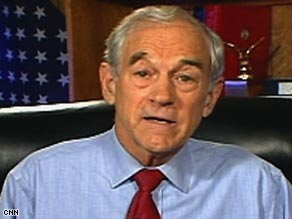
Ron Paul: 'Monetary system is fraudulent'

CNN) -- Former presidential candidate Ron Paul was interviewed Friday morning by CNN anchor John Roberts on "American Morning."
Rep. Ron Paul says that what really needs regulating is the  Federal Reserve.

Rep. Ron Paul says that what really needs regulating is the Federal Reserve.

Paul, a Republican from Texas, spoke from his home in Clute, Texas. The topic of the discussion was the current economic crisis and the Capitol Hill testimony Thursday of former Fed chief Alan Greenspan.

John Roberts, CNN anchor: Up there on the Hill, Alan Greenspan was basically saying, "Oops, I missed this one, sorry about it," but he was optimistic for the future. Congressman Paul, do you even listen to him anymore?

Rep. Ron Paul: I have to because somebody like you might ask me a question about him.

No, I don't really listen in the sense that I'm going to get a lot of new information. I used to listen to him when he was writing back in the '60s because he agreed with free market economics and no respect for the Federal Reserve.

Lately, though, I mean, he's been part of -- and right now he's really gotten bad because what he was saying yesterday was that the only place where he might have made a mistake is he didn't advocate more regulations.

Well, if you're a true free market person it isn't the lack of regulations. Trying to regulate and improve on the conditions that the government creates. I mean we created this problem. The Federal Reserve created this. The Community Reinvestment Act created it. The FDIC created it. Fannie Mae and Freddie Mac created it.

It was all seen there but now he says if we could have only had more regulations ...

Roberts: Right.

Paul: ... we could have salvaged this clogged system.

Roberts: Well, you believe that markets can be or should be self-regulating?

Paul: Well, to a degree, but the government does have a responsibility to deal with fraud, but the monetary system is fraudulent. Instead of perpetuating fraud in the monetary system they should be dealing with real fraud.

But just regulating prices -- that's what they're doing now, they're trying to regulate prices and set prices for these assets that hasn't -- have no value. So, no, that's not the kind of regulation we want, but there is certainly a role for regulations.

We should be regulating the Federal Reserve system is what we really ought to be regulating.

Roberts: Well, regardless of what we talk about this morning, the Dow is going to go off a cliff again today so let me turn to politics if I could.

A lot of people have said, particularly because of the economy, this is a bad year to be a Republican. John McCain behind in the national polls, seems to be behind in the battleground states as well. He's got a long and difficult road if he hopes to win the Oval Office.

If Republicans really take a beating, Congressman Paul, on November the 4th, where does that leave the Republican brand?

Paul: Well, I think they're in big trouble, but I think I mentioned that a year or so ago, that they've sort of lost their way. No, it's going to be a lot worse, but you have to say that the markets aren't being reassured about the obvious victory that's going to occur.

Then they said, "Oh, my, you know, we're going to have Obama and a Democratic Congress stronger than ever so things are going to get a lot better." They haven't discounted that yet.

The country is in a mess regardless, but I think the Republican Party really in a mess because ...

Roberts: I mean, I mean how ...

Paul: ... they'll probably lose a fair amount of seats again.

Roberts: How bad a blow could it be and how long might it take the party to rebuild?

Paul: You know, I was first elected -- I first ran in 1974, and I think there were about 145 members of Congress, Republicans, then. It took 20 years. So that is the case. But, you know, I think it's secondary to what the Congress is doing.

If both parties have bad ideas, it doesn't matter a whole lot. Right now ...

Roberts: And I wanted to ask you about ...

Paul: ... I think both parties follow those ideas.

Roberts: You're on the ballot in a couple of states. You're on the ballot in Louisiana. You're also on the ballot in Montana, and in Montana you were polling 4 percent there.

That's exactly the difference between Senator McCain and Barack Obama with Barack Obama on top. I mean you could be the spoiler here and take Montana away from Senator McCain, and I know that some Republicans, friendly to you, say hey, get off the ballot in Montana. You tried, you couldn't.

How are you going to feel if because of you McCain loses Montana?

Paul: Well, I think it will be a pretty far stretch if McCain loses the election that they're going to blame me. I haven't been campaigning in Montana. People who are supporting out there are spontaneous. They're enthusiastic. They don't like either candidate.

So I don't think the person whose name they picked is the one that does the spoiling. I think there's something else that is wrong. Maybe it's the flawed policies of both candidates.

Roberts: Congressman Paul, it's always good to see you. Thanks for joining us this morning. We'll check back with you again soon.

Paul: Thank you. Good to be with you.

Laser beam spy camera joins war on terrorism

By Jason Lewis

A laser that can scan a crowd and identify people who have been handling explosives is being secretly tested at British airports and railway stations.

The device - no bigger than a shoe box - could also be used by police and MI5 surveillance teams to identify Islamic terrorists outside mosques or community centres.

The laser can pick out suspects in large crowds and highlight explosive residue on their clothing and luggage.

It could also be used to guard against terrorists targeting the 2012 Olympics in London.

The Explosive Residue Detection system can be covertly attached to CCTV systems and automatically highlights people who may have been handling explosives or who recently fired a weapon.

Professor John Tyrer, of Loughborough University, who helped to develop the equipment, said: 'When you handle an explosive, the chemicals -such as Semtex and TNT - leave traces. With this technology we are able to see this telltale residue and identify possible suspects.

'Using laser technology we can see the explosives on people's clothes, on their hands or on items like backpacks such as those used by the July 7 London bombers.'

He added: 'This equipment could be carried by surveillance teams or could be set up to monitor a street, a railway, airport terminal or national stadium.'

When the equipment scans a crowd, it alerts an operator when explosive particles are detected. The system uses a combination of lasers and the latest camera technology to produce images showing the suspect and highlighting the explosive traces.

Once explosive residue is detected, the system automatically alerts the operator. It does not need to be constantly monitored.

Unlike sniffer dogs detecting particles in the air, the system can be operated just a few metres from a target without anyone knowing they are being monitored.

Prof Tyrer said the laser system would also pick up people who had legitimate reasons for handling explosives, such as police officers and firearms experts.

The team cannot say where their new equipment has been installed, revealing only that 'its operational uses have been recognised and would include airports, train stations, underground systems and ports, and would prove useful to police forces, forensic services and the military'.

Saturday, October 25, 2008

Iranian TV Director Said Mostaghasi Comments on MEMRI TV's Translation of "The Secret of Armageddon" and Declares: Jews Sent Columbus to Discover Amer

This interesting video from MEMRI TV

CERTIFICATE OF LIVE MUSLIM KENYAN BIRTH TO A WHITE LADY

Barack Obama’s actual birth certificate!

* Thanks to Tim Blair

Click on image to enlarge!

From Atlas:

JUDGE DISMISSES BIRTH CERTIFICATE LAWSUIT: ANYBODY GOT STANDING?

Philip Berg’s lawsuit has been dismissed by Clinton appointed Judge Surrick on the grounds that Berg lacked standing.

The analysis of the COLB presented on Obama’s fight the smears website should have been the basis of Berg’s lawsuit because it presents “reasonable suspicion”. Berg’s conjecture or speculation is irrelevant. If you remember, I was not pleased that is was Berg when he filed. The case must be made on evidence not speculation.

Prosecutor and reader John Jay remarked in the comments back in July:

Techdude is not running for President of the United States. His analysis is not subject to a standard of “proof beyond a reasonable” doubt.

Barrack Hussein Obama is running for President of the United States, and he has to meet and prove establish that he meets certain requirements to do so, e.g., age and citizenship. He has proofs of constitutional dimension in that regard, as must meet statutory and regulatory standards in filing for his candidacy, and proving his citizen ship and age.

He has political “proofs” of honesty and integrity as well.

The filing and.or flaunting of phonied up documents satisfy none of the proof requirements he faces, and would not in court.

This is a sad day for America. I cannot believe we are going to yawn and just take this

LAWSUIT AGAINST OBAMA DISMISSED BY PHILADELPHIA JUDGE America’s Right (hat tip peach)

The order and memorandum came down at approximately 6:15 p.m. on Friday. Philip Berg’s lawsuit challenging Illinois Sen. Barack Obama’s constitutional eligibility to serve as president of the United States had been dismissed by the Hon. R. Barclay Surrick on grounds that the Philadelphia attorney and former Deputy Attorney General for the Commonwealth of Pennsylvania lacked standing.

Surrick, it seemed, was not satisfied with the nature of evidence provided by Berg to support his allegations.

Various accounts, details and ambiguities from Obama’s childhood form the basis of Plaintiff’s allegation that Obama is not a natural born citizen of the United States. To support his contention, Plaintiff cites sources as varied as the Rainbow Edition News Letter … and the television news tabloid Inside Edition. These sources and others lead Plaintiff to conclude that Obama is either a citizen of his father’s native Kenya, by birth there or through operation of U.S. law; or that Obama became a citizen of Indonesia by relinquishing his prior citizenship (American or Kenyan) when he moved there with his mother in 1967. Either way, in Plaintiff’s opinion, Obama does not have the requisite qualifications for the Presidency that the Natural Born Citizen Clause mandates. The Amended Complaint alleges that Obama has actively covered up this information and that the other named Defendants are complicit in Obama’s cover-up.

A judge’s attitude toward the factual foundation of a plaintiff’s claims is an essential factor in understanding just who indeed has standing to sue. The question running to the heart of the standing doctrine is whether or not the plaintiff indeed has a personal stake in the outcome of the otherwise justiciable matter being adjudicated. As has been discussed before many times here at America’s Right, a plaintiff wishing to have standing to sue must show (1) a particularized injury-in-fact, (2) evidence showing that that the party being sued actually caused the plaintiff’s particularized injury-in-fact, and (3) that adjudication of the matter would actually provide redress.

In this case, Judge Surrick’s attitude toward the evidence presented by Berg to support his allegations figures in heavily because, while there is a three-pronged test to standing in itself, there is no definitive test by which the court can determine whether a certain harm is enough to satisfy the first element of that three-pronged test by showing true injury-in-fact. Traditionally, it hasn’t taken much to satisfy the need for an injury-in-fact, but as the plaintiff’s claimed injury is perceived as being more remote, more creative, or more speculative, the injury-in-fact requirement becomes more difficult to satisfy.

[....]

Who, who does have standing? According to the Hon. R. Barclay Surrick, that’s completely up to Congress to decide.

If, through the political process, Congress determines that citizens, voters, or party members should police the Constitution’s eligibility requirements for the Presidency, then it is free to pass laws conferring standing on individuals like Plaintiff. Until that time, voters do not have standing to bring the sort of challenge that Plaintiff attempts to bring in the Amended Complaint.

Read it all. But like I said, the analysis presented at Atlas should have been entered into evidence.

So what if I, we were wrong. I would have egg on my face? I don’t care - I was presented with strong evidence. What was worst the that could happen if we were wrong, a bitchslap from the leftards. So what?

Whats the worst that could happen if we were right. Traitor in the White House.

You weigh it. The judge certainly didn’t.